
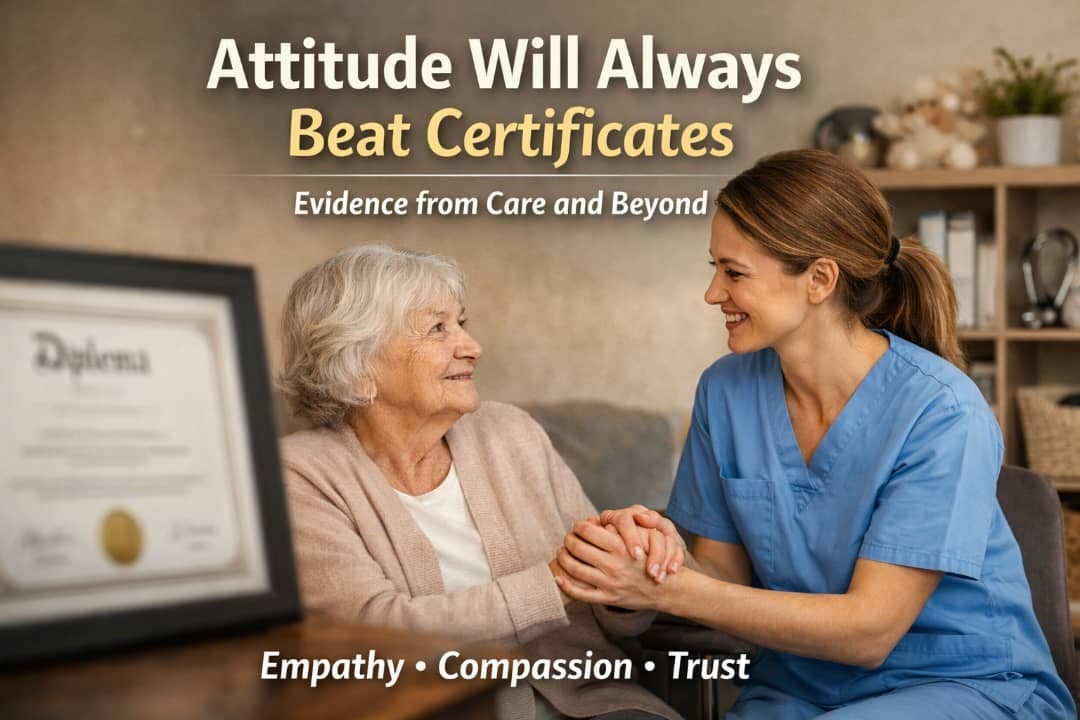
Attitude Will Always Beat Certificates: Evidence from Care and Beyond
Attitude is not about pretending everything is easy. Care work can be exhausting, underpaid, and emotionally heavy.
In a world that increasingly values credentials, titles, and framed certificates on office walls, it’s easy to assume that qualification equals competence. Degrees matter. Certifications matter. Training matters. But in caregiving and in many other professions there is something that quietly but consistently makes the difference between average service and transformative impact: attitude. Over the years, both research and lived experience have shown that non-technical qualities such as empathy, emotional intelligence, compassion, patience, diligence and integrity often determine performance outcomes just as much as, and sometimes more than, formal qualifications. Nowhere is this more evident than in care.
What Evidence Suggests
Across healthcare and social care settings, studies consistently highlight the role of “soft skills” in patient satisfaction, treatment adherence, team collaboration, and overall wellbeing outcomes. While technical competence ensures safety and accuracy, relational competence builds trust and trust changes everything. In caregiving environments, residents and families rarely remember:
· The caregiver’s certificate grade.
· The exact terminology used.
· The technical steps of a procedure.
But they always remember:
· How they were spoken to.
· Whether they felt respected.
· Whether someone truly listened.
· Whether they felt safe.
That difference is not academic. It is deeply human.
Care Is More Than Clinical Skill
In eldercare, disability support, and home-based recovery, caregiving happens in intimate spaces, homes, hospital bedsides, and moments of vulnerability. These are spaces where people are adjusting to loss, fear, dependence, or uncertainty. A caregiver may hold multiple certifications. But if they lack patience, kindness, and emotional awareness, those certificates cannot compensate for relational gaps.
On the other hand, a caregiver with a learning mind-set, humility, and compassion often grows into technical excellence because attitude fuels growth. Attitude determines:
· Willingness to learn
· Responsiveness to feedback
· Team collaboration
· Ethical conduct
· Resilience under pressure
Certificates qualify you to start. But attitude determines how far you go.
Beyond Care: A Universal Pattern
This principle is not limited to healthcare. In corporate environments, research on leadership effectiveness consistently highlights emotional intelligence as a predictor of success. In education, teacher-student relationships influence learning outcomes more than subject mastery alone. In customer service, tone and empathy often outweigh product knowledge in shaping customer loyalty. Across sectors, we see the same pattern:
· Technical skills open the door.
· Character and attitude build the house.
Why This Matters Now
As industries evolve, automation and artificial intelligence are increasingly handling technical and procedural tasks. What remains distinctly human and irreplaceable is empathy, emotional presence, ethical judgment, and relational intelligence. Especially in caregiving, where dignity, trust, and vulnerability intersect daily, attitude is not optional. It is foundational. This does not mean certifications are unimportant. They are essential for safety, regulation, and competence. But they are incomplete without the human qualities that bring them to life. A certificate proves you passed an exam. But attitude proves you understand people.
Implications for Recruitment and Training
If we accept that attitude significantly influences outcomes, then organisations must rethink how they recruit and train. Beyond verifying credentials, we should be asking:
· Does this person demonstrate empathy?
· Do they listen actively?
· Are they teachable?
· Do they show integrity in small things?
· How do they respond under stress?
Technical skills can be taught. But character is revealed. For training institutions, this means embedding emotional intelligence, communication skills, and ethical reasoning into curriculum design not as add-ons, but as core competencies.
The Human Advantage
Caregiving reminds us of a simple truth: people do not only need services; they need connection. In the quiet moments—helping someone dress, assisting with mobility, sitting beside a hospital bed—what often matters most is not the certificate on the wall, but the posture of the heart. Attitude shapes tone. Tone shapes trust. Trust shapes outcomes. And that is evidence enough. In the end, certificates may open opportunities. But attitude sustains impact.
A Message to Caregivers
To every caregiver whether you work in a hospital, a residential home, a community facility, or someone’s living room this is for you.
You stand at the intersection of skill and humanity.
Your work is measured in charts, care plans, and task lists, but the people you care for experience it in tone of voice, facial expressions, and the quiet way you show up, again and again, even on the hard days.
You may sometimes feel that you are “just” a caregiver, especially when surrounded by professionals with higher titles or more certificates.
Yet evidence repeatedly shows that the qualities you bring—kindness, patience, attentiveness, and respect—strongly influence how safe, valued, and hopeful people feel in your care. Long after procedures are forgotten, the memory of how you made someone feel remains.
This is not an argument against training or qualifications. Your technical skills prevent harm and save lives. Rather, it is a reminder that your greatest impact often comes from the invisible things:
· Taking an extra minute to listen, even when you are busy.
· Explaining what you are doing so a person feels included, not managed.
· Preserving dignity in the smallest acts of personal care.
· Choosing not to let your own stress spill onto those who are already vulnerable.
Attitude is not about pretending everything is easy. Care work can be exhausting, underpaid, and emotionally heavy. There will be days you feel unappreciated or overwhelmed. In those moments, protecting your own wellbeing—seeking support, resting when you can, asking for supervision, setting healthy boundaries—is not selfish; it is what allows you to keep offering the best of yourself.
So let this be both an affirmation and a challenge:
· An affirmation that what you do matters far beyond what any certificate can show. Every act of gentleness, every moment of genuine presence, is part of a much larger story of human dignity.
· A challenge to keep cultivating the attitudes that make you not only a competent caregiver, but a transformative one: curiosity instead of judgment, compassion instead of indifference, integrity instead of shortcuts, and humility instead of ego.
You may never see your name on a wall plaque or in a journal article, but you are often the difference between care that is merely delivered and care that is truly felt. In a world that counts qualifications, remember that the people you care for are counting something else: your humanity.
Attitude is not a small accessory to your role; it is the very heart of it. BE KIND!
About the Author
Theodore Ihenetu
I am passionate about building accessible residential care and nursing homes for older adults and individuals with special care needs. With a background in Social Gerontology (social work with older adults), Early Childhood and Primary Education and a PhD (in view) at the University of Nigeria, Nsukka, my work bridges research, faith, and frontline care. I collaborate with allied healthcare professionals and non-profit partners to develop practical, tech-enabled solutions that help older adults and care partners live safely, confidently, and with dignity, whether at home or in residential care settings.
Stay Connected
Sign up for our free newsletter to receive updates, stories, and ways to get involved.